
Tree Planting Bristol: Structure and Shade for Your Garden
Bristol has lost a great deal of mature canopy in recent years. Ash dieback disease has forced the removal of ash trees across the city, and Bristol City Council has been working through a canopy recovery programme to replace some of what has gone. Planting proposals for sites such as Allerton Road in BS14 and Hudds Vale open space in St George set out three and five heavy standard trees respectively, chosen to put canopy back into streets and green spaces that lost it.
The same logic plays out in private gardens, just at a different scale. One well-chosen tree can give a plot height, shade, privacy and a sense of maturity that borders and lawns simply cannot provide. Get the species and the position right, and the tree shapes the garden for years to come. Get them wrong and you have a maintenance problem that grows annually.
Reading the Local Picture Before You Choose a Tree
It helps to know what Bristol is planting and why, because public schemes reveal which species are considered suitable for the area. The proposals published for the ash dieback canopy recovery project list species including field maple (Acer campestre), tulip tree (Liriodendron tulipifera) and hawthorn (Crataegus monogyna). These are the kind of choices worth discussing for a domestic garden, although scale and position will decide whether any of them suits your space.
Elsewhere in the city, Bristol Water helped plant more than 900 trees across one autumn and winter planting season, with species including English oak and silver birch, as part of work to enhance habitats. A separate carbon balancing programme linked to 9Trees had 1,300 trees ready to go into the ground. Pucklechurch Wood is the first stage of a project that organisers say will see more than 22,000 native trees planted in one season, followed by a further 22,000 the following winter.
Residents do not have to be passive observers of all this. Bristol City Council publishes tree planting proposals for individual sites and invites comments by email at onetreeperchild@bristol.gov.uk, with a deadline set for each one. Local residents have also discussed sponsorship routes such as Trees for Streets as a way to fund new planting. Bristol Tree Forum is a useful reference point for the city’s tree heritage, including the Anne Frank ginkgo planted in her memory on 12 June 2009, on what would have been her 80th birthday.
What a Tree Actually Does for a Garden Layout
A tree is the only element in a garden that changes the space above your head. Borders, lawns and terraces organise the ground plane. Trees organise everything else: the skyline of the plot, the way light falls across a border in the afternoon, the distance between your seating area and the neighbours’ upstairs windows. That is why designers tend to place trees early and arrange everything else around them.
Structure and Proportion
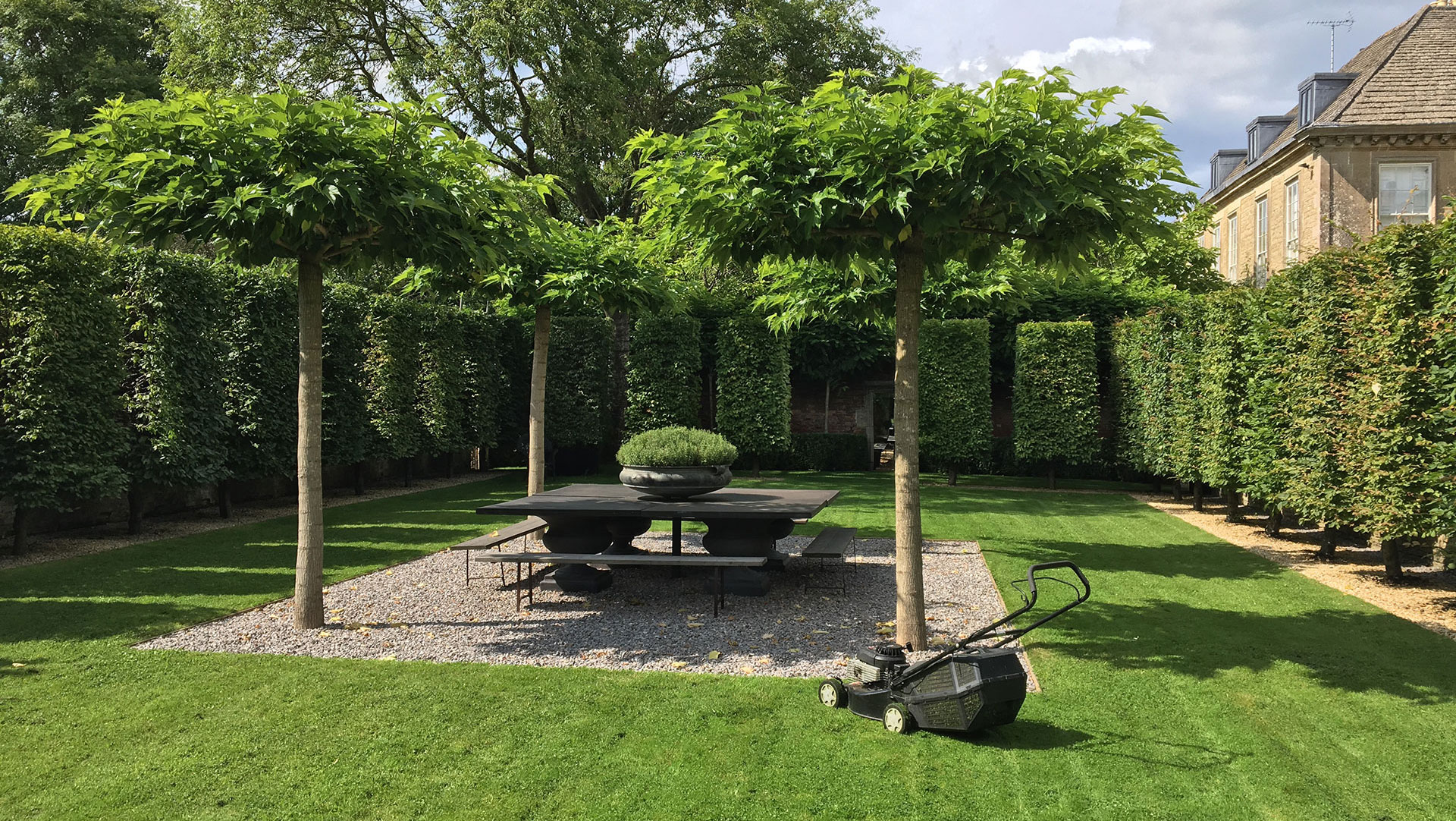
Structure is the skeleton a garden hangs on, and trees provide its largest pieces. A single tree can anchor a flat, overlooked plot, mark the end of a lawn or separate one part of a garden from another without building a wall. In a small space, a tree with a clear trunk and a high canopy adds height without stealing much ground, which is often the difference between a garden that feels generous and one that feels cramped.
Shade That Lands Where You Want It
Shade is a design decision, not an accident. Position determines which part of the garden is comfortable on a hot afternoon and which part stays in full sun. A tree placed to the south or west of a terrace will throw shade across it later in the day; the same tree on the opposite side of the plot does something entirely different. Canopy shape matters as well, because a broad, spreading crown casts a wide pool of shade while a narrow, upright form leaves far more of the garden in light.
Screening, Shelter and Seasonal Interest
Trees also screen. A canopy placed between a seating area and a neighbouring property adds privacy without the shut-in feeling of a solid fence, filtering a view rather than blocking it. Seasonal interest is part of the value too: blossom, catkins, autumn colour, bark and the structure of bare branches in winter keep a garden working through the year, and a canopy provides food and habitat for birds and insects at the same time.
Matching the Right Tree to the Right Spot
Species choice is where most planting decisions succeed or fail. A tree that suits one garden can become a permanent problem in another, so selection should follow the site rather than preference alone.
Space Above and Below Ground
The room a tree needs is not simply the spread of its branches. Rooting area, distance from foundations, drains, services, paths and boundaries all matter, as does the eventual height relative to windows, roofs and overhead cables. Heavy standard trees, the large nursery-grown specimens used in Bristol’s public planting proposals, need more space and more careful handling than young whips, but they also deliver immediate presence. Matching the specification of the tree to the space available is the most useful decision you will make.
Aspect, Soil and Site Conditions
Aspect decides how much sun a tree receives and how exposed it will be to wind. Soil decides how well it establishes. Both vary from garden to garden, sometimes within a few metres, which is why a site visit tells you more than any general rule. A tree that thrives on a free-draining slope may struggle in a wet corner, and a species that performs well in a sheltered space may suffer on an exposed ridge.
Climate Resilience and Long-Term Thinking
Professional planting plans now weigh climate resilience alongside appearance, which is why both native and non-native species appear in modern schemes. A mix spreads risk: if one species struggles with a pest, a disease or a run of difficult seasons, others carry the planting. The same principle holds in a private garden, where two or three different trees will usually outperform a row of identical ones.
What a Professional Tree Planting Service Covers
Good planting starts long before a spade goes in. Specialist services in the Bristol area typically begin with advice on species selection and planting locations, then move on to long-term care so that new trees establish successfully and thrive. The practical scope usually includes native and non-native species chosen for climate resilience, replacement planting where trees have been removed, planting plans for larger sites, aftercare advice and ongoing maintenance, with quality stock sourced from nurseries and planted to industry standards.
What matters to a homeowner is the sequence. The tree is chosen for the site, the position is set out on the ground, the soil is prepared properly, the tree is planted to a recognised standard and then looked after through its first seasons. Cutting any of those steps short is what produces the disappointing results people describe when a new tree sulks, leans or fails altogether.
Design First, Planting Second
The tree in a garden layout is usually too important to add as an afterthought. It belongs in the plan, drawn at scale, with its canopy and rooting space accounted for alongside paving, lawns, borders and lighting. Compass Garden & Landscape Design works on exactly that basis across Bristol, Bath, Wiltshire and the wider South of England, combining bespoke garden design with soft landscaping and plant consultancy. The practice is led by award-winning designer Tom Murphy, and projects range from period homes and new builds to terraced gardens and front gardens.
Plant supply and consultancy form part of the service, so trees and other planting can be sourced at trade prices and matched to a custom planting plan rather than whatever happens to be available locally. A design consultation, booked through a call-back at a time that suits you, is the usual starting point.
A Sensible Order of Work
- Walk the garden at different times of day and note where sun and shade fall, which corners are exposed and where you actually sit.
- Decide what the tree is for: shade over a terrace, privacy, a focal point, autumn colour, wildlife or screening an ugly view.
- Check the space above and below ground, including overhead cables, drains, services, boundaries and distance from the house.
- Confirm ownership and any permissions or restrictions if the tree is not going into your own private garden.
- Choose a species and specification that suits the site, then have the position set out before anything is planted.
- Plant to an industry standard, water through the first seasons and follow an aftercare plan.
Getting Involved With Bristol’s Wider Tree Planting
The city’s planting effort is bigger than any single garden. Bristol City Council publishes proposals for individual sites, invites comments by email and sets a deadline for each one, so residents can respond to plans for their street or local open space. Community programmes such as One Tree Per Child link into those proposals, and sponsorship schemes give residents another way to contribute. Volunteering and sponsorship details change over time, so check the current position with the organisation running the scheme before you commit to anything.
Frequently Asked Questions
When is the best time of year to plant a tree in Bristol?
Local planting schemes around Bristol run through the autumn and winter planting season, which is when most bare root and root-balled stock is moved and planted. Container grown trees are more forgiving of other timings. Ask your supplier or designer for the right window for the species you have chosen, and check current guidance from the relevant official source if you are unsure.
Do I need permission to plant a tree in my garden?
For a tree planted on land you own and occupy, the decision is normally yours, but you should check whether any restriction applies to your property and speak to the relevant official source if in doubt. Trees on council land, verges, public open spaces and shared grounds are different, and Bristol City Council publishes planting proposals for those sites and invites comments by email.
Can I sponsor or help plant a tree in Bristol?
Yes, there are routes to get involved. Residents have discussed sponsoring tree planting through Trees for Streets, and Bristol City Council’s One Tree Per Child programme links to the planting proposals published for individual sites. Details change from scheme to scheme, so check the current information from the council or the sponsorship scheme before you pledge anything.
How long does a new tree take to establish?
Establishment depends on the species, the size of tree planted, the soil, the weather in the first few seasons and the aftercare it receives. This is why reputable planting services advise on long-term care as well as the planting itself, and why aftercare and maintenance are usually included in the scope of a professional job. A heavy standard tree needs more support than a young whip.
Which trees suit a small Bristol garden?
Species used in Bristol planting proposals, such as field maple and hawthorn, are worth discussing with a designer, while larger species such as tulip tree suit plots with room to grow. Size, aspect, soil and how much shade you want all affect the answer. A site visit and a planting plan will tell you far more than a generic list of names.